

Why preserved flowers change color (and what you can actually do about it)
You've been scrolling through preserved flower art on Instagram. The colors look gorgeous. Vivid roses, crisp whites, lush greenery. And you're wondering: will my bouquet look like that? Or will it come out brown, faded, or completely different from what I remember?
Here's the honest answer: Unless they are color corrected, every preserved flower changes color. Every single one. The question isn't whether it will happen. It's how much, how fast, and whether you’re okay with it.
I want to tell you the story of when this really hit home for me. A client sent me her wedding bouquet, which included toffee roses. Toffee roses are this gorgeous warm almond color when fresh. During pressing, they turned purple. Deep, rich, unmistakably purple. When she saw the design mockup, she told me she disliked the color. And she was right to feel that way. She'd chosen those flowers for a reason, and the preserved version looked like a completely different bouquet.
Right that moment, I decided to include color correction as a standard part of every commission in my Chicago-based flower preservation practice, Bloom & Make. If someone invests in quality flower preservation, they deserve artwork that looks like their flowers and holds up over the years. No surprise purples. No unexplained browning. No watching their piece fade into something unrecognizable within a year.
This guide is the information I wish every bride knew before making decisions about their flowers. I'll walk you through why color change happens, which flowers are most affected, what the preservation world does about it, and how to make an informed choice about your own piece.
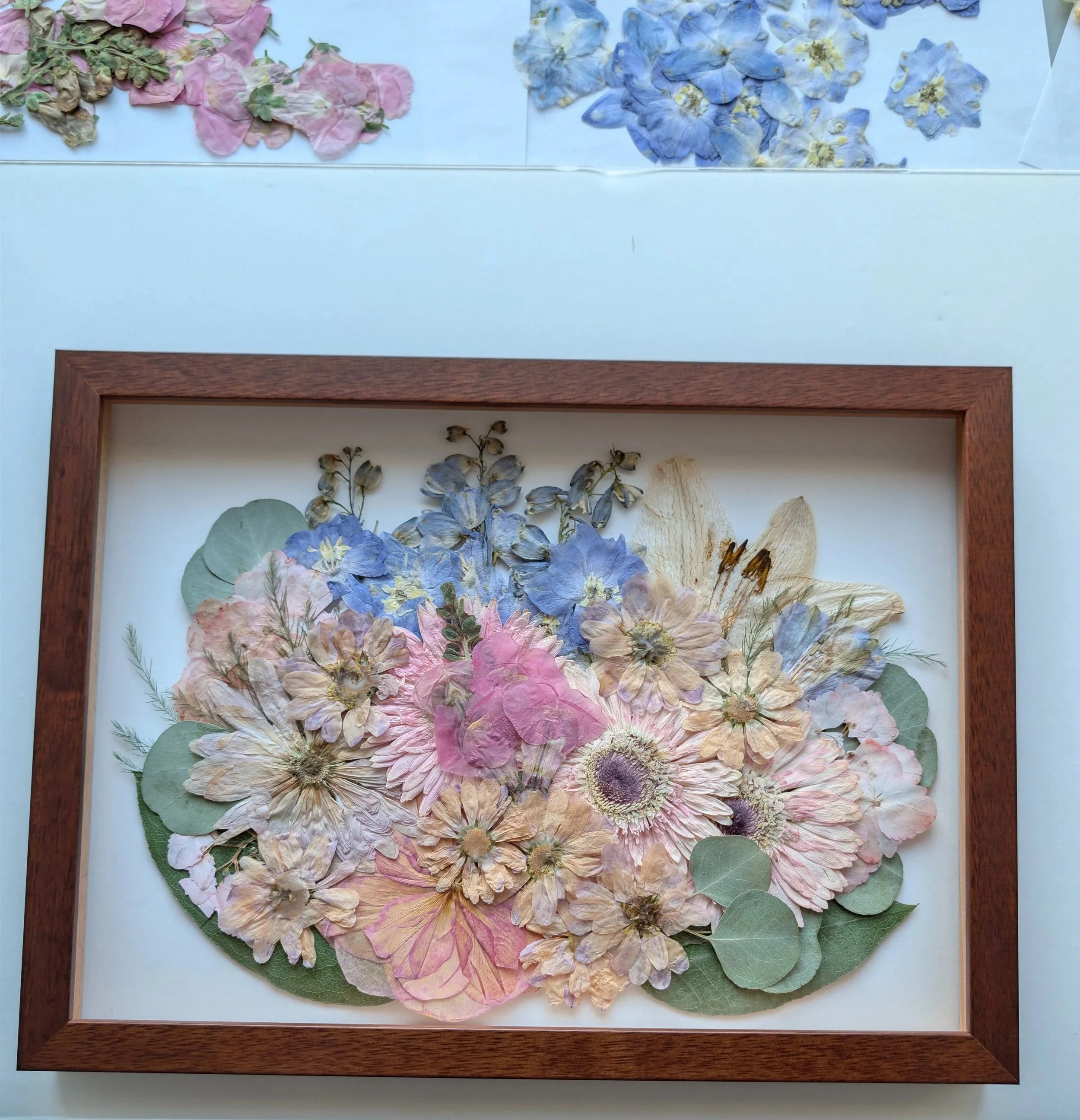
Before correction
In this design mock-up, the pink and lilac pastels faded while I stored them for about 10 months. The coral garden rose at the bottom of the arrangement faded almost completely.
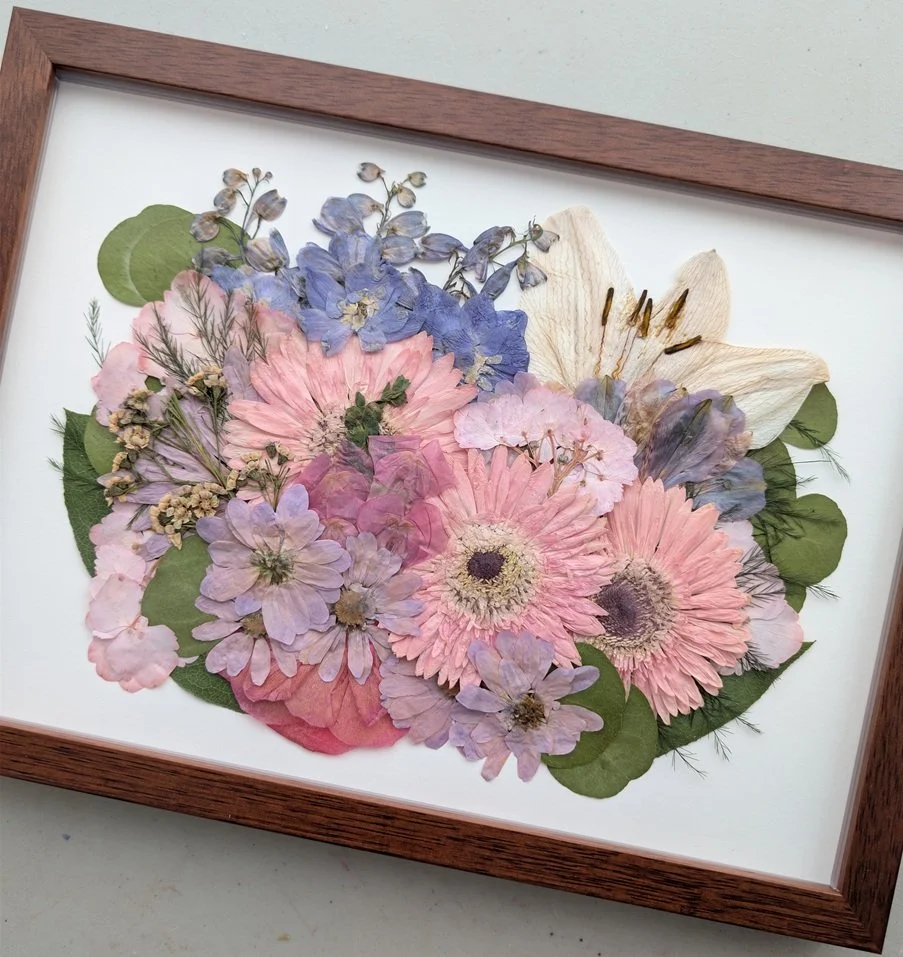
After color correction
I color corrected every single flower and piece of greenery to restore the gentle pastels. Translucent pigments applied to the pink hydrangeas give the blooms a natural (not painted) look.
Why flowers change color when preserved
Flower color comes from pigments inside the cells of each petal. Anthocyanins produce reds, purples, and pinks. Carotenoids create yellows and oranges. Chlorophyll is responsible for green. These pigments are suspended in fluid inside living cells, and the way light passes through that fluid is part of what makes fresh flowers look so vibrant.
When you preserve a flower, three things happen to those pigments. Understanding them helps make sense of everything else in this guide.
Pigment breakdown
Removing moisture from a flower concentrates, shifts, and sometimes destroys pigments. Reds and purples darken because anthocyanins oxidize when exposed to air, similar to how a cut apple browns. White flowers have almost no pigment to hold onto, so once the water leaves the cells, the underlying cell structure shows through. That structure is brownish. It's why whites are the single trickiest color to preserve.
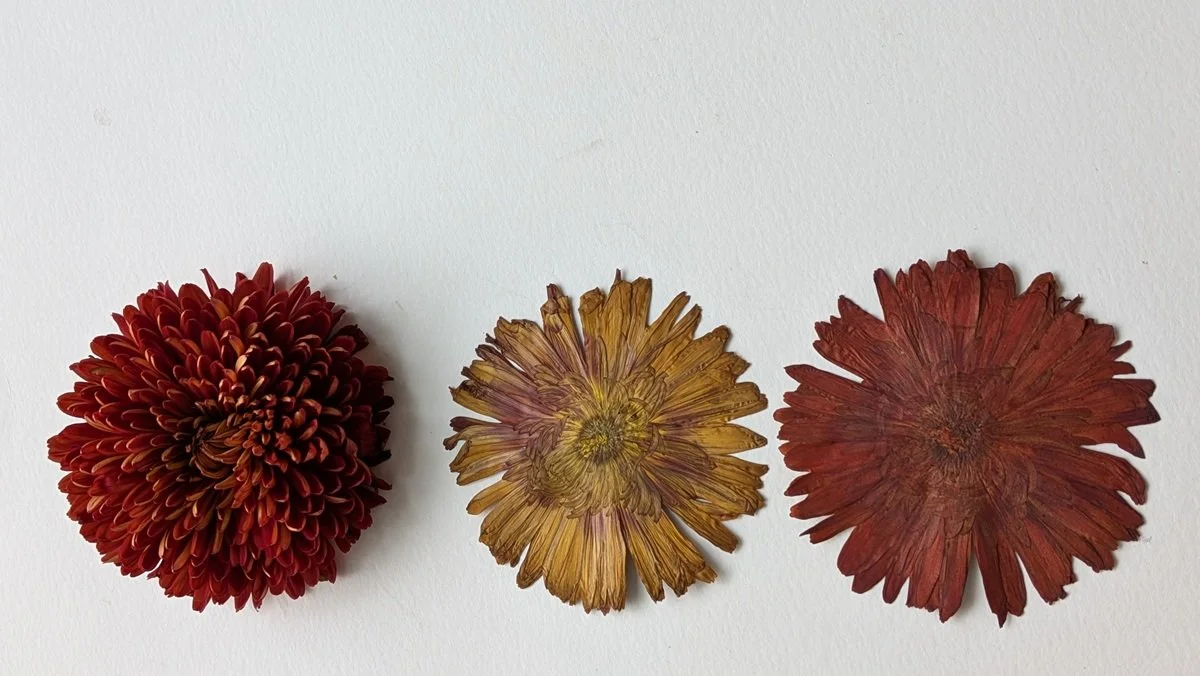
Temperamental mums
This is a striking example of how dramatic color change can be. These are three identical mums: the left is fresh, the middle is pressed, and the right is pressed and color corrected. While the uncorrected pressed mum looks beautiful (to me at least), in professional flower preservation, it would not meet quality standards.
Moisture removal
The same process that preserves the flower also transforms it. Plump and translucent petals become flat and opaque. Colors that depended on light passing through hydrated tissue look different when that tissue is dry and dense. A fresh blush rose petal is like stained glass. A pressed one is more like paper. The color is still there, but you're seeing it under completely different conditions.
Light and time
UV light breaks down pigments after preservation. This is a separate timeline from the initial pressing shift. The color change during pressing happens over days to weeks. The slow fade on your wall happens over months and years. Even a couple of hours of direct sunlight each day will speed this up noticeably. This is why archival materials, especially UV-protective glass, make such a measurable difference in how long your piece holds its color.
Which flowers change the most (and which hold up)
After pressing tens of thousands of flowers for hundreds of Chicago brides, I can tell you this with confidence: the darker the flower's color, the better it will hold up over time. That rule applies across nearly every variety I've worked with (with a couple of exceptions - I’m looking at you, mums and orchids!). Here's what to expect, color by color.
Whites: the trickiest category
This is the number one source of surprise for clients. White flowers have so little pigment that even under ideal conditions, they'll shift toward ivory within weeks of pressing and often toward light brown within about six months. The browning is particularly visible at the base of petals, where they connect to the center of the flower. That's where moisture gets trapped and where the cell structure is thickest.
This is exactly why some preservation studios won't accept all-white bouquets at all. I do accept them, and I'm upfront with clients about what to expect. Because I include color correction in my process, white flowers stay mostly light ivory for a long time. Without correction, they'll brown. That's the reality. If you're planning an all-white bouquet for a Chicago wedding and wondering whether preservation is even possible, the answer is yes. It just requires an artist who knows how to handle them.
One technique that makes a real difference for light-colored roses: I deconstruct them. Rather than pressing a whole rose and hoping moisture doesn't get trapped between overlapping petals, I take the flower apart and press individual petals. Then I reassemble them in the design. It's significantly more labor, but it prevents the browning that happens when the base of the petals overlap and hold moisture during pressing.
Pinks and blush tones
Light pinks are the most likely to lose all visible pigment. I've watched blush roses go from a soft pink to essentially nothing within a few months. Some blush varieties shift toward purple during pressing, which is another surprise for clients who weren't expecting it. The lighter the starting pink, the more dramatic the loss will be. Deeper pinks hold up much better.
Reds and burgundies
For most flowers (notable exception: mums), deep pigments work in your favor here. Reds darken to burgundy during pressing, and burgundies can go nearly black. That sounds dramatic, but the color is still there. It reads as rich and moody, and it holds for years. If your bouquet is heavy on deep reds and burgundies, your piece will age gracefully.
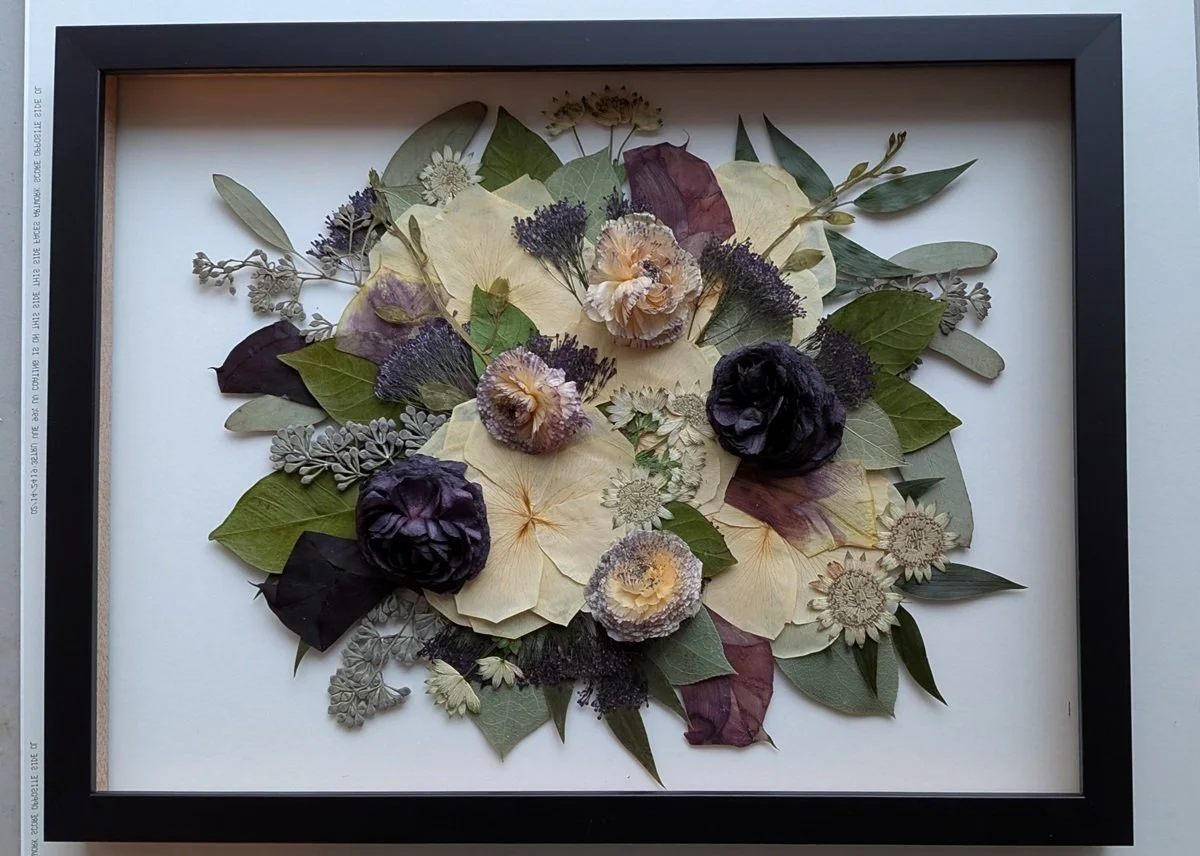
Before correction
The burgundy cala lilies and ranunculus darkened during preservation but still retained their rich hues.
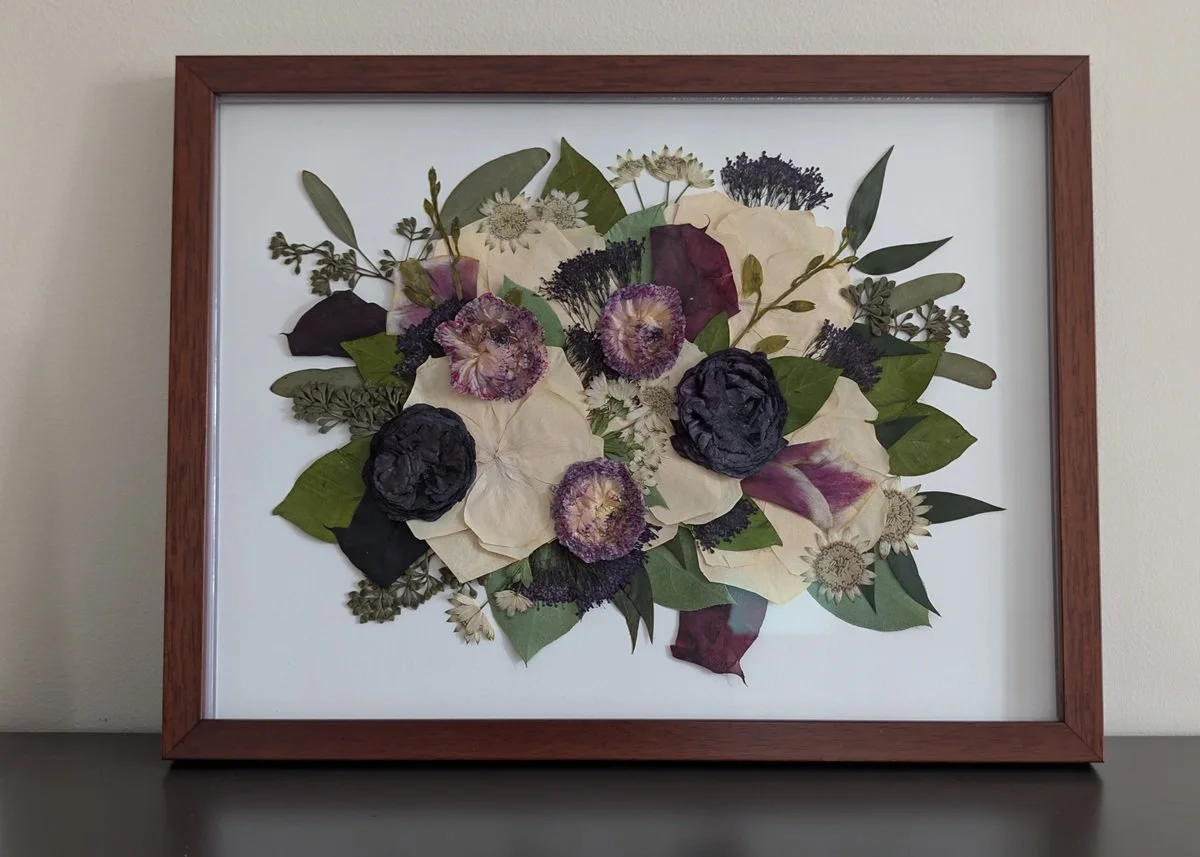
After color correction
I wanted to restore some of the brighter hues of the fresh bouquet and lighten up the ivory roses. A light application of different shades of green to the foliage creates dimension without overwhelming the natural texture.
Yellows and oranges
These fade within roughly two years, even under ideal conditions. Orange and yellow ranunculus are particularly fast to lose color. After pressing, yellow undertones tend to emerge as the dominant color in flowers that started out peach or orange. The warm tones recede and what's left is a muted gold. My own garden piece with orange dahlias, grown in my Chicago cutting garden, shows this clearly at three years old.
Blues and purples
The best performers in the preservation world. Delphinium, dark hydrangea, and the dark purple edges of sweet peas all hold their color for years. If longevity matters to you, these are your allies. I have a piece made with sweet peas from my garden in 2022. The dark purple edges still look vivid. The stems, on the other hand, lost their green a while ago.
Greenery and foliage
Eucalyptus holds up reasonably well. Most other foliage fades to light brown relatively quickly. Ferns lose color entirely. If your bouquet has a lot of greenery, expect the greens to be the first thing that changes. This is one reason I recommend correcting the entire arrangement rather than just the flowers.
The flowers that surprise people most
A few varieties deserve a specific mention because clients almost always expect them to preserve well, and they don't.
Garden roses, especially coral and peach varieties. These are some of the most popular wedding flowers, and they're also the fastest to lose all color. Within about eight months, coral and peach garden roses can go completely blank. It's a total loss of pigment, not just a subtle shift.
Orange and yellow ranunculus. Quick faders, often within a few months.
Lighter shades of pink stock. The pale ones lose color fast. Darker stock does better.
Sunflowers. They lose their signature yellow within about a year.
Tulips, especially white and pastel. Pastels fade quickly, and whites go the same direction as white roses.
Hellebores. Despite their beautiful muted tones when fresh, they don't hold. In fact, even when fresh, some varieties change color as days pass. For example, certain white varieties turn green.
Why pressed flowers turn brown
This is the most common question I see online, and it deserves a thorough answer. Browning comes from several sources, and understanding them helps whether you're pressing flowers at home or evaluating a professional's work.
Moisture
The number one cause. When moisture stays trapped between petals during pressing, it creates browning and, if left long enough, mold. Professional pressing involves a strict schedule of changing the blotting paper that absorbs moisture as it leaves the flowers. Miss a paper change, press in a humid room, or leave flowers sitting in a closed book for weeks without checking, and browning is almost guaranteed.
Timing
Flowers that were past their peak when they went into the press will carry that age with them. There's a visible difference between a rose pressed at 24 hours after cutting versus one pressed at day five. The cells have already started breaking down, and pressing can't reverse that. This is why preservation artists emphasize getting your flowers to them as quickly as possible after the wedding.
Bruising
Some flowers, especially white roses, bruise very easily. The bruising often isn't visible on fresh petals. It hides, then shows up after pressing as brown spots or discoloration. By then, there's nothing to be done about it. Your bouquet goes through a lot on your wedding day: being held, tossed, set down, picked up, photographed in sun, carried back inside. All of that handling can create bruises that don't appear until weeks later in the press.
Water drops
Accidental water on petals, whether from condensation during shipping, from the florist's spray, or from handling, will brown during pressing. This is one reason shipping all-white bouquets requires extra care. A single droplet trapped on a petal can leave a permanent brown mark.
The shipping factor
If you're searching for flower preservation near you in the Chicago area, proximity matters for color. Local drop-off means your flowers spend zero time in a shipping box, which reduces the risk of condensation, bruising, and the general stress that causes browning. I've seen bouquets arrive after overnight shipping with water damage that would have been completely avoidable with a local handoff. For white and light-colored bouquets especially, working with a preservation artist you can reach in person makes a real difference in the final result.
If you do need to ship your flowers, work with a reputable artist who stands by their work. That means they either offer color correction to restore what shipping may have taken away, or they offer flower replacement options if blooms arrive too far gone to preserve well. A good artist will be honest with you about the condition of your flowers when they arrive.
That said, there’s an important reality to acknowledge. Even the most reputable artists and studios cannot be held responsible for flowers that are damaged during shipping due to extreme weather, improper packaging, or rough handling by the carrier. These things are outside anyone’s control. I recommend insuring your shipment for the real value of your bouquet, not just the shipping cost, and asking your artist to photograph the flowers upon delivery if they notice any issues. That documentation protects everyone and sets clear expectations about what the artist is working with.
The DIY gap
If you've tried pressing flowers at home and ended up with brown results, you're not alone. Home pressing (heavy book, forgot about it for a few weeks, no paper changes) produces browning because there's no humidity control, no paper-changing schedule, and no climate-controlled environment. These aren't failures of effort. They're the result of not having the right setup. Professional preservationists control for all of these variables, which is why the results look different.
The detail most people don't know
Professional pressing often means deconstructing flowers. That lush rose in a preserved frame was likely taken apart and rebuilt petal by petal. For light-colored roses especially, pressing the whole flower creates browning where petals overlap at the base and trap moisture. Taking the flower apart and pressing individual petals eliminates that problem. When you see a beautifully preserved white rose in someone's frame, there's a good chance that rose was in 20 separate pieces before it was reassembled.
How long do preserved flowers keep their color?
There are two separate timelines to understand, and most people mix them up.
The first is the initial color shift during preservation. This happens over days to weeks as the flowers dry and press. It's the toffee-to-purple transformation, the white-to-ivory drift. This shift is immediate and significant. It's also where color correction does its most important work.
The second is the slow fade on your wall. This happens over months and years after the piece is framed. It's gradual, and it depends heavily on your display conditions and the materials used in framing.
With archival materials and color correction
At one year, most flowers look close to how they did when framed. At two to three years, darker colors still hold well, and lighter colors may show some softening. At five years and beyond, lighter tones fade noticeably, but the piece still reads as colorful and intentional. My garden dahlia piece is over three years old. The dark dahlias look almost the same as when I framed them. The white dahlia has stayed surprisingly white. The orange ones and the foliage show clear fading.
With archival materials and no color correction
Light-colored flowers start showing visible change within months. Coral and peach garden roses can lose all color within eight months. Whites will brown. Darker colors hold, but without correction to keep everything cohesive, you'll eventually have a piece where some elements look vibrant and others look washed out.
Without archival materials
UV-protective glass blocks 99% of the light that causes fading. Standard glass lets it through. Acid-free matting won't yellow or degrade over decades. Standard matting will. A piece framed with standard materials might look identical to an archival piece on day one. Five years later, the difference is obvious. The materials are doing invisible work every single day.
Display conditions matter too. A piece on a shaded interior wall in a climate-controlled room will age better than one that catches afternoon sun or hangs above a heating vent. I've written more about this in my guide on how long flowers really last, which covers display and care recommendations in detail.
What color correction actually is
Color correction means restoring or enhancing the color of preserved flowers using pigments applied by hand. That's the simple version. It's not spray-painting a flower a completely new color. It's not dyeing. It's not making artificial flowers. It's bringing back what the preservation process took away.
How I do it
I combine several methods, with a preference for sprays designed specifically for flowers. The application is light. The goal is to take the edge off, not to overwhelm. For flowers that have lost significant color, I layer lightly and use translucent sprays to build depth gradually. Subtlety takes practice. It took me a long time to master the balance between enough correction to make a difference and too much correction that loses the organic quality of the flower.
My philosophy
Color correction should be subtle and never forced. I always err on the side of less, even if that means more color change over time. The natural texture and sheen of the petals should remain visible. When you look closely at a corrected flower, you should still see the veins, the slight irregularities, the translucency at the edges. Those details are what make it a real flower and not a painting of one.
Why I correct everything, not just the problem flowers
Some artists correct only the flowers that changed most visibly. I correct the entire arrangement: every bloom, every leaf, every piece of foliage. Here's why.
Over time, uncorrected flowers and foliage will continue fading while the corrected elements hold their color. A piece that was selectively corrected eventually becomes a patchwork. Some flowers look vibrant. Others look washed out. The eye notices the inconsistency, even if you can't put your finger on what's wrong. Correcting everything keeps the piece aging as a cohesive whole. The entire composition softens together over the years, rather than falling apart visually.
I always recommend correcting the entire arrangement or not correcting at all. The middle ground tends to create more problems than it solves.
[PHOTO: Side-by-side of the same flower variety with and without color correction]
What overdone color correction looks like (and how to spot it)
Color correction is controversial in the preservation world. Some artists treat their techniques as trade secrets. Others don't offer it at all. And some, in my opinion, take it too far. I think you deserve to know what to look for.
From what I've seen, heavy correction tends to fall into two categories.
The too-perfect transformation
Every petal is heavily colored, shaded, and sometimes trimmed or shaped. The result is an almost paper-like quality, with flowers looking more manufactured than preserved. It's a distinct aesthetic. Some people genuinely prefer it because of its graphic, polished look. If that appeals to you, there are studios that specialize in it. It's worth knowing the style exists so you can make an informed choice.
The flat painted look
This happens when someone applies straight acrylic or heavy pastels to each petal. The natural sheen and texture of the flower disappears completely. Everything looks flat and matte, lacking the small imperfections and organic quality that make preserved flowers feel real. You can spot this in portfolios: if every flower looks uniformly smooth and evenly colored, regardless of variety, the correction is doing more than restoring.
What to look for when evaluating an artist's work
Ask to see corrected pieces that are two or more years old. Fresh work always looks good. Aged work tells you whether the correction holds up and whether it still looks natural over time. Look for variation within individual petals. Real flowers have lighter edges, darker centers, slight inconsistencies. If every petal is one uniform shade, that's a sign of heavy correction. And if every white rose in their portfolio looks identically crisp white, ask questions about their approach.
In my own work, I never attempt to make white roses bright white. I layer ivory color with a light white application to achieve something that looks natural. That stark, painted-white look is jarring and reads as artificial. The goal is a flower that looks like itself, not like a ceramic replica.
Natural aging vs. color correction: how to decide
Neither choice is wrong. This is about what matters to you.
When natural aging works
Some people love watching their piece evolve. The gradual fading tells a story about time passing, the same way the flowers themselves are a story about a specific day. For bouquets heavy on deep reds, purples, and blues, natural aging can be genuinely beautiful because those pigments hold for years. The piece just deepens and mellows.
When correction makes the difference
All-white bouquets. Bouquets with lots of coral or peach garden roses. Anything with chrysanthemums, which change dramatically during pressing. Toffee roses. Arrangements where a large portion of the flowers are light-colored. In these cases, correction is what makes the piece look like your bouquet rather than a version of it you don't recognize.
One exception to know about
For previously dried and restored flowers that will be used in resin work, I don't recommend correction. Corrected flowers can look heavy and may discolor on contact with resin. In every other case, I recommend it.
Questions to ask any preservation artist
Is color correction included in your price, or is it an add-on? Do you correct the entire arrangement or only select flowers? Can I see corrected pieces that are two or more years old? Can you show me examples of the same flower with and without correction? What happens if I don't like the correction result?
The answers will tell you a lot about how the artist thinks about color and whether their approach matches what you want for your piece.
Your flowers, your choice
Color change is part of working with real flowers. It's part of what makes preserved art different from a photograph. The petals in your frame were alive once. They went through a transformation, and they'll continue changing slowly, on your wall, as years pass.
The question is how much say you want in how that transformation looks. Understanding the science, knowing which flowers are prone to dramatic shifts, and asking the right questions about correction gives you that say.
If you're in the Chicago area and have flowers you're thinking about preserving, I'd love to talk through what to expect for your specific bouquet. I work with clients across Chicago and the surrounding suburbs, from the North Shore to the western suburbs and everywhere in between. Every arrangement is different, and sometimes a quick conversation is all it takes to set your mind at ease. You can reach me through my website to start that conversation.