

How long do flowers really last? Fresh vs. preserved comparison
Here's the math that catches most people off guard. You spend weeks choosing your wedding flowers. You invest thousands of dollars in arrangements that take your breath away. And within a week of your wedding, they're wilting in a vase or browning in a trash bag.
Cut flowers weren't designed to last. That's part of what makes them special. The question is whether you're comfortable with that impermanence for flowers that mark the most significant moments of your life.
The lifespan of flowers depends entirely on what you do with them. Fresh flowers, air-dried flowers, and professionally preserved flowers exist on completely different timelines. I want to walk through each category honestly so you can make an informed decision about your own blooms.
How long do fresh flowers actually last?
Cut flowers in a vase typically last 5 to 14 days, depending on the variety. Some flowers are marathon runners. Others start fading almost immediately.
Roses hold up for 7 to 10 days with proper care. Peonies give you 5 to 7 days if you're lucky. Hydrangeas can last a week, though they'll wilt dramatically if they dry out even once. Tulips stretch to about a week. Carnations surprise people by lasting 2 to 3 weeks. Dahlias, despite their beauty, are notoriously short-lived at 3 to 5 days.
Wedding bouquets face even tougher conditions. Your florist typically assembles arrangements 1 to 2 days before the wedding. By the time you're walking down the aisle, those flowers are already 24 to 48 hours old. They spend your wedding day out of water, handled constantly, photographed in direct sunlight, and exposed to temperature swings between air-conditioned venues and outdoor ceremonies.
By the reception, your bouquet has been through a marathon. Most bouquets are visibly past their prime within a week of the wedding. The flowers you invested so much in selecting have a functional lifespan of about seven days.
A few factors accelerate the decline. Heat speeds up wilting. Direct sunlight fades colors and dries petals. Bacteria in vase water clogs stems and blocks hydration. And here's one most people don't know: the ethylene gas released by fruits and vegetables causes flowers to age faster. If you put your bouquet in the kitchen refrigerator next to your produce, you're shortening its life.
How long do air-dried flowers last?
Most people who want to keep their flowers try air-drying first. It's free, it's intuitive, and it feels like you're doing something to preserve the memory. You hang the bouquet upside down in a closet, wait a few weeks, and hope for the best.
Realistic lifespan: 1 to 3 years before significant deterioration.
The results vary wildly. Some bouquets hold their shape reasonably well. Others turn into brittle, faded shadows of themselves within months. The difference comes down to factors most people can't control: the humidity in your home, whether the flowers were fully dry before you stopped monitoring them, how much light exposure they get, and the specific flower varieties in your arrangement.
What deterioration looks like: colors fade dramatically, especially whites and pastels. Petals become so brittle they crumble when touched. Dust accumulates in crevices you can't clean without causing damage. And if any moisture was trapped during drying, mold can develop months later.
I hear the same story constantly from clients. They air-dried their bouquet with the best intentions. It sat in a closet because it didn't look display-worthy. A year or two later, they pulled it out and found a fragile, faded bundle that made them sad rather than happy. They wish they'd done something different from the start.
Air-drying works for casual keepsakes or flowers without high emotional stakes. The trade-off is that the result rarely matches the memory you're trying to preserve.
How long do professionally preserved flowers last?
The difference between air-drying and professional preservation comes down to materials. Archival-quality framing uses acid-free matting that won't yellow or degrade over decades. Museum glass blocks 99% of UV light, the primary cause of fading. Proper sealing protects against humidity fluctuations that cause brittleness and mold. When preservation artists talk about pieces lasting years, they're assuming these materials were used. Cheaper alternatives cut the lifespan dramatically. A piece framed with standard glass and non-archival matting might look identical on day one, but five years later, the difference becomes obvious.
Color correction matters as much as framing materials. Pressed flowers that aren't color corrected will visibly fade and discolor surprisingly fast, sometimes in less than a year, even when framed with museum-grade materials.
Certain flowers are particularly prone to rapid color change: white roses (some varieties turn brown), coral garden roses, tulips, white stock, coral charm peonies, most yellow flowers (including ranunculus), ferns (they fade completely), and mums. On the other hand, dark purple, red, and blue flowers like roses, delphinium, ranunculus, peonies, and some dahlias retain their color naturally for several years.
Some studios and artists don't offer color correction at all. Others charge extra for it. In my practice, it's always included because preservation is a significant investment and I want every piece to hold up over time.
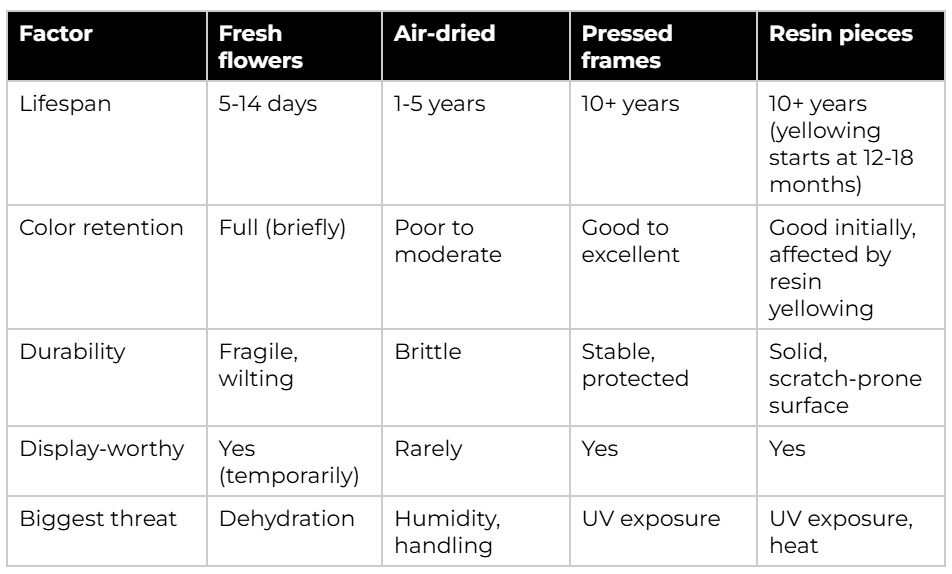
A quick comparison of fresh vs preserved flowers
What determines how long your piece lasts
Two identical bouquets preserved by the same artist can age completely differently depending on how they're displayed. The variables are within your control.
Sunlight is the primary enemy. Every hour of direct sun exposure accelerates fading. A piece displayed on a wall that catches afternoon light will show noticeable color loss within a few years. The same piece on a shaded interior wall might look unchanged after a decade. If you have a spot you love that gets direct light, museum glass becomes essential rather than optional.
Humidity matters more than most people realize. Extremely dry environments can cause pressed flowers to become brittle over time. High-humidity environments create conditions for mold, even in sealed frames, if the seal isn't perfect. The ideal range is 30-50% relative humidity, which is comfortable for humans as well.
Temperature swings cause expansion and contraction that can stress delicate preserved materials. A piece hung above a heating vent, working fireplace or on an exterior wall that gets hot in summer and cold in winter will age faster than one on a stable interior wall.
What if your flowers have already started to fade?
The window for preserving fresh flowers is narrow. Ideal timing is within 1 to 3 days of the event, with flowers kept cool and hydrated. Up to a week is workable if conditions were good, though some color loss is likely. Beyond a week, the flowers have typically deteriorated too much for optimal results.
For bouquets that have already been air-dried, restoration is sometimes possible. I've developed techniques to rehydrate and press flowers that were dried months or even years ago. The results depend on how far gone the flowers are and whether mold has developed. Mold is the one absolute deal-breaker. Once it's present, the bouquet can't be safely restored.
For flowers that are genuinely too far gone, recreation offers another path. I can source flowers that match your original arrangement and preserve those instead. It won't be the exact bouquet you carried, but it captures the same varieties, colors, and composition. Several of my clients have chosen this option and found it meaningful despite the flowers being different.
What I include in every piece
If you're considering preservation and want to know what to expect from my practice: every pressed flower frame I create in my art practice, Bloom & Make, includes museum-grade materials. Acid-free matting, UV-protective glass, archival backing. These aren't upgrades or add-ons. They're standard because I want the piece you hang on your wall today to look beautiful in 20 years.
I also include gentle color restoration on every commission. Some flowers hold their color naturally. Others need help to look like themselves after pressing. Either way, you won't receive a piece that starts fading within a year.
If you're in the Chicago area and have flowers you're not ready to let go of, I'd love to hear from you. Reach out through my inquiry form to start a conversation about your bouquet.